Tuesday, November 15, 2016

Compare/Contrast Essays

Compare/Contrast Essay


Writing a Compare/Contrast Essay 
Here is some general information about writing this type of essay:
• A comparison essay notes either similarities.
• A contrast essay notes only differences.
• The comparison or contrast should make a point or serve a purpose. Often such essays do one of the following: Clarify something unknown or not well understood. Lead to a fresh insight or new way of viewing something. Bring one or both of the subjects into sharper focus. Show that one subject is better than the other. 
• The essay can present the subjects and indicate whether they will be compared, contrasted, or both.
• The same points should be discussed for both subjects; it is not necessary, however to give both subjects the same degree of development.
• Some common organizational structures include: (see note below) Block method (subject by subject) Point by point Comparisons followed by contrasts (or the reverse)
• Use detailed topic sentences and the following connecting words to make the relationship between your subjects clear to your reader:

Connectors That Show Comparison (Similarities)
In addition
Correspondingly
Compared to
Similarly
Just as
As well as
Likewise
Same as
At the same time

Connectors That Show Contrast (Differences)
However
On the contrary
On the other hand
Even though
In contrast
Although
Unlike
Conversely
Meanwhile

Reference: SBCC

Other topics for Comparison/Contrast essays:
1. Books vs. Movies
2. Living in the City vs Living in the Province (Inaka)
3. Organic vs Genetically Modified Food
4. Email vs SMS
5. High School vs College
6. Democracy vs Military Governments
7. Getting Married vs Staying Single
8. Digital Technology vs Analog Technology
9. Working Full-time vs Working Part-time
10. Having Children vs Not Having Children

Tuesday, October 18, 2016

Obon: Japan's Halloween by Ai Faithy Perez on Lifestyle

If you’ve been in Japan for a while, you may have heard the word obon floating around during these excruciatingly hot summer months. Obon (お盆) or just bon (盆) is a Buddhist custom held in honor of one's ancestors. During obon, families prepare to receive the ones who have "gone on," typically by returning to their hometown and visiting the deceased’s grave, cleaning the tombstone and bringing fresh flowers. 

Cemetary by Emran Kassim cropped

Even though obon isn’t a national holiday, it’s not uncommon for the work force (who rarely take their paid holidays) to take leave during the second week of August to visit hometowns and be with family. The three days of obon depend on the area—if you live in Tokyo, Yokohama or in the Tohoku region you’ll have a Shichigatsu (July) Obon. In Shikoku, the Chugoku region and Okinawa, obon is called Kyu Bon (Old Obon). Elsewhere you celebrate Hachigatsu (August)Obon.

When I first heard of it being described as a celebration or festival, I thought to myself, surely it’s disrespectful to celebrate the death of one’s ancestors. Apparently, the Japanese are a glass-half-full type of people and rather see it as an opportunity to see loved ones again.

Obon has been celebrated in Japan for nearly 500 years, and traditionally people danced to lure the spirits of their ancestors home. This dance is called Bon Odori (盆踊り) or “bon dance.” The dance is a joyous one. You can’t help but smile when your hands are in the air, swaying from side to side, jostling with the random neighboring swayers. If I told you the story behind the bon dance, you’d mutter “uso!” (ウソ!), which literally means “lie.”

Bon Odori originates from the story of Maha Maudgalyayana (Mokuren), one of the disciples of Buddha, who used his supernatural powers to find his deceased mother. Upon finding her, he discovered that she was in the realm of the Hungry Ghosts and was suffering. Distressed, he consulted Buddha, who instructed Maha to make offerings to the many Buddhist monks on the fifteenth day of the seventh month. Maha bowed and obeyed. And upon his mother’s release, he put his arms in the air and did a victory dance, or rather, what we now know as the Bon Odori.


Bon Odori photos by Guilhem Vellut; cemetery photo by Emran Kassim.

October 19 UPDATE

l

Presentation TODAY is CANCELLED, instead today will be an additional day to prepare for your presentation. Please improve your slides, add more pictures, double-check your spelling.
A few suggestions for your slide presentations:

  1. Put your names on the Title Slide.
  2. Our topic this time is about JOB HUNTING, you may use charts, and graphs, to help you easily explain your data.
  3. The last slide is usually a "Thank you" slide. You may write "Thank you for listening." Or if you have a last message for your listeners, you may put that in your closing slide.
Presentations will be NEXT WEEK (October 26, 2016). Please use the extra time for preparation. Feel free to email me if you have any questions.

Tuesday, October 11, 2016

Job Hunting Suit

I'd like to focus on one part of this list though, and that is suits. Recently there has been some controversy about this and a lot of raging has occurred on the Japanese internets.
It all started with an article in the "Weekly Toyo Keizai" titled "Choose a black suit for shuukatsu job hunting! – Do not try to stand out with clothes". This was published on October 28, 2014. According to the article, 90% of recruits wear black suits so it suggests that other applicants should follow the majority to be safe. As an example, they compared the reactions of what an interviewer might think if you wore a "unique" striped suit versus a normal black one:
What would an interviewer think if you wore a stripe designed suit for an interview? The reaction of the interviewer will be one of three types.
  1. They'll evaluate it as a positive, as in "a striped suit is better because it's different from others."
  2. They are not interested in a graduate's clothes, so they don't take it for a positive or a negative.
  3. They evaluate it as a negative, as in "he/she doesn't know manners, wearing a striped suit for a job interview is too flashy to make a good impression."
We don't know which reaction is likely because we haven't researched it, but let's assume that each case has equal possibility – a three in one chance. In that case, if you wear a black simple suit to an interview, the interviewer wouldn't react in any particular way since most applicants wear a black plain suit anyways. It's neither positive or negative, but neutral, so it can be said there is no risk if you choose a black suit.
However, if you wear a striped suit to an interview, an interviewer could get a negative impression of you one-third of the time. It's quite a big difference, isn't it? You don't need to take any risks intentionally. Instead of standing out by appearance, you should try standing out by who you are and impress the interviewers with what you say.
What's the point of this article? A country where recruits wear "uniforms". I deliberately want to say that this is a worthless and pointless article. It's stupid. Adults who do or say such things are just idiots (regarding "choose black suits for shuukatsu job hunting!"). – @kenichiromogi
There are a lot of meaningless rules for appearances in Japan – @ys1dream
This article is really stupid, isn't it? Is it saying not to demonstrate personality? When I was job-hunting, it took me a while to get a job offer. I ended up hating both the look and wear of my suit and went to an interview in jeans and a jacket with a pair of sneakers in the end… then I got an offer. Wearing casual clothes makes you relaxed, so I recommend it." - @mii_sang3791
I think it's correct not to join a company which decides who to hire only by the color of their suits. - @mizutamabeat
Shoji Kokami, a Japanese playwright, director, and filmmaker, agreed to Mr. Mogi's tweet and stated his opinion in three tweets.
For example, imagine if there was a child who doesn't want to use a satchel and his/her parents persuaded/begged/commanded/encouraged the child to use it. In that case, I respect parents who can tell their child not "you won't be bullied if you use the satchel" but "this country doesn't allow diversity, but hopefully it will change when you will become adult." I never ever want to be a person who confidently tells a child "when you graduate from university, you will have to wear a recruit suit, which is a satchel for adults, or else you won't be accepted. It's all for your benefit." Instead, I want to be someone who can talk about my true feelings about the recruit suit – containing opinions about both those who agree with the black suit and those who are not comfortable with it. That would be a steady step, though it's a small step, to reduce this country's stuffiness and light a fire of hope. I think an adult who can do such things is a wonderful adult. - @KOKAMIShoji
Of course, there were counterarguments to the counterarguments. Things are really getting heated! All just for the color of a suit!
Freelance writer Tomohiro Akagi wrote a blog post with his opinion. Aft first he took it for granted that there are people who feel uncomfortable or question if using black suits is the right thing to do after reading Toyo Keizai's original article. He said that if a recruit asked him what was best to wear for a job interview, he would tell them to choose a black suit because the purpose of job-hunting is not to wear a colorful suit but to obtain a job offer. If there is a risk in wearing a unique colored suit, then the best advice certainly would be to follow the majority. After making these introductory remarks, he took up the main subject, which is "where do Mr. Mogi and the others' angers come from?"
Akagi assumed that they got upset with the fact that an individual person with their own personality is treated in a uniform manner because they grew up in the period when people made a strong appeal not to wear school uniforms but to wear whatever they like in their school days. He concluded that their opinion comes from believing that accepting a variety of clothes equals accepting a variety of personalities.
Then he pointed out that graduates who were currently job-hunting were very used to wearing school uniforms so they know how to take advantage of it. Especially "high school girls", who have become a sort of icon, which means they benefit from a consumer society, which equals having their value recognized by society. Because of that, they don't have any doubts about wearing the same black suit like everybody else. This means that the "worthlessness" or "stuffiness" that Mr. Mogi and the others insist on only exists in their own generation and there is a high possibility that such ideas don't exist at all among the current recruits.
In that way, it clears up why I doubted their anger. I guess whoever feels worthless or stuffy from the sight of all applicants wearing black suits are only Mr. Mogi or Mr. Kokami. Therefore, I think the truth of their anger is that they are using recruits as chessmen in a proxy war to fulfill their self-respect.

Job Hunting in Japan

Source: https://www.tofugu.com/japan/job-hunting-in-japan/

Like the Eskimos and their many words for snow, there are quite a few words to describe job-hunting in Japan. Shokusagashi 職探ししょくさがし and kyuushoku 求職きゅうしょく have the same meaning as "job-hunting" in English, referring to the general act of looking for employment. Tenshoku katsudou 転職活動てんしょくかつどう refers to looking for a change of occupation. Shuushoku katsudo 就職活動しゅうしょく-かつど, aka "shuukatsu" for short, refers to the job-hunting process of fresh high-school and college graduates.
The reason for all of these different "job-hunting" rules is thanks to the unique hiring practices of the Japanese. The biggest and uniquest of these has to be the shinsotsu ikkatsu saiyou 新卒一括採用しんそついっかつさいよう, where many companies simultaneously hire students in bulk. Before 1997 there was an official date where companies could start their recruitments. If you started before this date it was called aotagari 青田刈あおたが, which literally means "harvesting rice while still green." After 1997 the new guidelines suggested that companies should announce recruitments on December 1 (for third year students) and start screening applicants on April 1 (for fourth year students). Just recently, the Abe Cabinet requested these dates get pushed back further so that students could focus on their studies. 2016 graduates will now wait until March 1 for recruitment to begin and August 1 for the screening to start.
Because companies hire all at once, they compete first for the students of the better schools because they tend to have "better" students. This puts more pressure on high school students, because if you can get into a good university you're more likely to get a good job, even if you don't do much studying once you get there. This system also makes university students join companies earlier. If you wait too long, there are fewer of these finite jobs left remaining. To put it bluntly, students really feel like they need to get a job during this shinsotsu-ikkatsu-saiyou period. If they don't, they'll find it very difficult to find ideal work. They even lose their advantage for the next year, because companies focus on fresh graduates, not one-year-old meat.

THE UNWRITTEN RULES OF JOB-HUNTING IN JAPAN


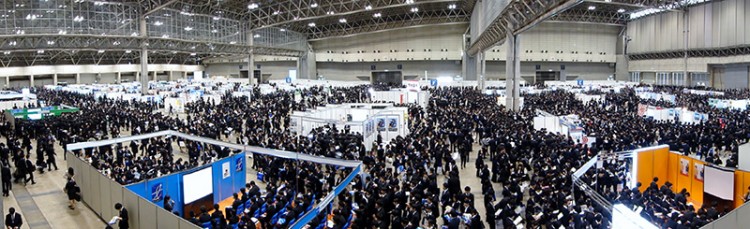
Thousands of people at a Japanese job fair

Already, you can see there is a lot of pressure on students to get a job, with a lot of rules and order to go along with it. It doesn't stop there, though. A huge list of "unwritten rules" exists for these students too. If you don't do these things, it's more unlikely that you'll be able to get a job. Just in terms of your looks there's a huge list you need to follow.

HAIRSTYLE

  • Should be short enough for the ears to show and be combed neatly (men).
  • The ears should show and be combed or tied neatly (women).
  • It has to be clean.
  • It shouldn't be dyed.

MUSTACHE / BEARD

CLOTHING

  • You should wear a typical dark suit appropriate for a job interview.
  • A single suit with two buttons is better than a double suit.
  • The top button must be fastened.
  • The shirt must be white.
  • The necktie should be simple.
  • There should be a neat crease in the trousers.
  • The color of socks should be a similar color to the suit.

SHOES

  • They must be simple and the color should be black or brown.
  • They must be polished well.

MAKE-UP

  • It should be simple and not flashy.
  • It's better not to use perfume.

NAILS

  • Nails must be cut nicely.
  • It's better not to put on nail polish.

EARRING/PIERCING

  • It's better not to wear them

NECKLACE

  • Must be simple and not flashy.

WOMEN'S CLOTHING

  • It should be a typical dark suit appropriate for a job interview.
  • Black, dark blue, or gray is safe.
  • If it's a skirt, it must not be too short.
  • A white shirt is safe.
  • The pantyhose must not have a run.

WOMEN'S SHOES

  • They must be a simple pair of pumps.
  • Their color should match the color of the suit.
  • The heels shouldn't be too high.
  • They must be polished well.
Despite being "unwritten rules", a lot of people think they are very important (and many of these people are on the hiring end of the table). If you don't do all these things you're less likely to get hired, and with lifetime employment still "a thing" in Japan, you want to get the best job that you can as early as you can. That or risk living at home in your parent's shrine playing Pokémon cards for the rest of your life.

Tuesday, October 4, 2016

Efficient Ways to Learn English


Source: http://www.ecenglish.com/learnenglish/lessons/the-most-efficient-ways-learn-english

What is the difference between effective and efficient? Let's say you had to travel from Rome to Paris; what means of transportation would you use? You could walk, run, ride a bike, drive a car, use a motorcycle, take a train, or fly (by plane). All of these methods of transportation are effective, they work; you will get there. But, which methods require the least amount of energy and accomplish the job in the shortest period of time? These methods are the most efficient. I am sure you would agree that traveling by plane is more efficient than riding a bike although Lance Armstrong might not agree.
Learning English can be broken down into two areas: input and output. Input consists of reading and listening while output consists of writing and speaking. Clearly, in order to have good quality output, you must have a lot of good quality input. Think of how long a child listens before beginning to speak. As adults, we are not going to wait two years before attempting to speak, but the more input we get, the more output we can produce. The same applies for reading and writing. The more you read, the better you write. I can even say that the more you read, write and listen, the better you speak.
My advice to all serious English learners is to approach your goal with a sense of urgency. That means you need to work effectively, but more importantly, you need to work efficiently. Based on my years of teaching and studying foreign languages, I have put together what I consider to be the most effective and efficient ways to develop each area of language.

Input

Reading

Learn at least five new vocabulary words every day. My suggestion is to use index cards with the word on one side and the definition on the other. Keep the cards in a box and review them frequently by saying the word and trying to give the definition. Keep the definitions as short and concise as possible. Five to seven words is best. If you learn five words a day, that’s 1,825 words per year. Considering that the average high school student probably has a vocabulary of 5,000 to 6,000 words, in a few years your vocabulary should be sufficient enough to understand nearly everything written in English.
Time commitment: 30 minutes.

Listening

Listen to talk radio. The objective of listening to English is to hear as many words as possible in as short a period as possible. The more times you hear a word, the better you will be able to use that word. There is no more efficient way to do this than talk radio. The vocabulary is very diverse and there are no periods of silence because unlike television, visuals cannot be used to keep an audiences attention. The key is to listen as often as possible. Maximize your time by listening to talk radio when doing other activities such as driving, walking, cooking, eating, getting dressed. If you can, try keeping the radio on while you go to sleep so it's the last thing you hear while falling asleep and the first thing you hear as you wake up.
Time commitment: 0.

Output

Writing

Keep a journal and write at least 500 words per day. By writing every day you will be reinforcing everything you have learned. It will also force you to question the accuracy of what you are writing. This process of intense concentration will help organize the vast array of information you have in your subconscious mind. Write about whatever you want, but be sure to challenge yourself with new vocabulary and various grammar structures.
Time commitment: 30 minutes.

Speaking

Read aloud. Reading aloud allows you to practice perfectly. Remember that it is perfect practice that makes perfect. By reading aloud you are speaking grammatically perfect English. If you have a typical conversation, errors will be made. Not just for English learners, but for native speakers as well. If  errors are repeated continually, it becomes increasingly more difficult to correct those errors. Also, you will be using vocabulary words that you would not normally use. In a typical one hour conversation, you might speak for 30 minutes with a number of errors, but if you read aloud, you can speak for one hour without any grammar mistakes using new vocabulary words.
Time commitment: 1-2 hours minimum.
Do these four things each day for one month and I promise you that you will be amazed at your improvement. There are no secrets to language acquisition, just a lot of hard work to accomplish something that will enhance your life forever.